- jeet@pitchperfectindia.com
- Monday to Friday : 9:00 AM to 6:00 PM
- Saturday & Sunday : 9:00 AM to 1:00 PM




Blog – Copy
- Home
- Blog – Copy
REVERSE ENGINEERING YOUR SALES PIPELINE
I was sitting in a boardroom with a Sales Head who was furious. His team had made hundreds of calls. Attended every meeting. Sent proposal after proposal.
And still missed their ₹5 Crore target by a mile.
He looked at me and said: “I don’t understand. They did everything right.”
I asked him one question: “When did they start?” That silence told me everything. The problem wasn’t effort. It wasn’t skill. It wasn’t even the market.
The problem was that his team was farming a pipeline they should have planted three months ago – and nobody had done the math to realize it.
That’s what Reverse Engineering your Sales Pipeline reveals. And once you see it, you can never unsee it.
First, Understand the Four Buckets :-
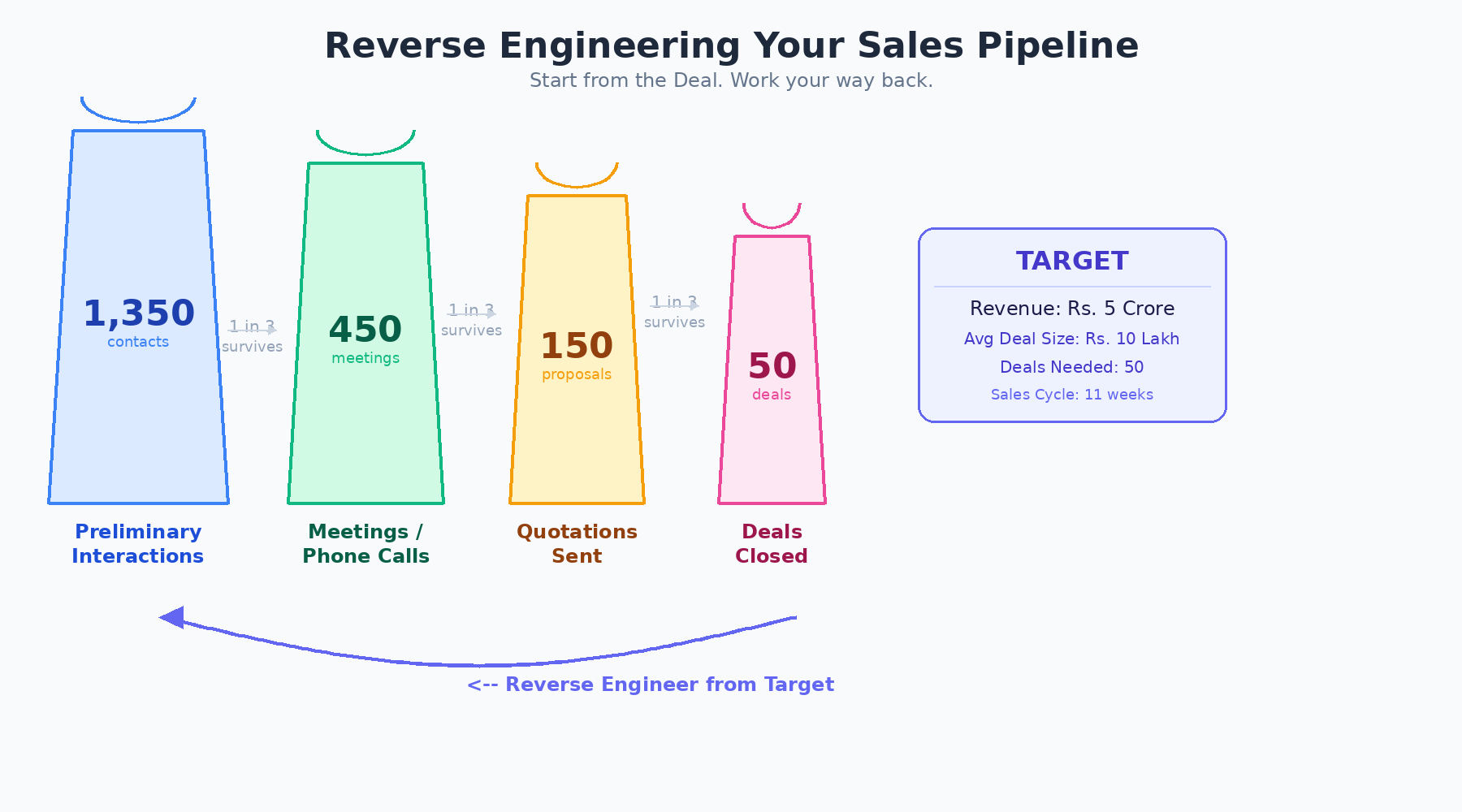
Think of your pipeline as four buckets, arranged from largest on the left to smallest on the right:
Preliminary Interactions → Meetings / Phone Calls → Quotations Sent → Deals Closed ✓
Every prospect enters from the left. Only a few make it to the right.
The question is: how many do you need at each stage to hit your revenue goal?
What Is Reverse Engineering a Sales Pipeline?
Instead of asking “How many leads do we have?”, you flip the question:
“How many deals do we need to close – and how many prospects must enter the pipeline to make that happen?”
You start with your revenue target and work backwards, stage by stage, until you know exactly what activity is required at the very beginning of the funnel.
– Let’s Work Through a Real Example
Revenue Target: ₹5 Crore
Average Revenue per Customer: ₹10 Lakh
Survival Rate per Stage: 1 in 3 (≈33%)
Preliminary Interaction → Meeting: 4 weeks
Meeting → Quotation: 1 week
Quotation → Deal Closed: 6 weeks
Step 1: How Many Deals Do You Need? ₹5,00,00,000 ÷ ₹10,00,000 = 50 Deals
Step 2: Work Backwards Through Each Stage Since only 1 in 3 prospects survive each stage:
Deals Closed → 50
Quotations Sent → 50 × 3 = 150
Meetings / Calls Held → 150 × 3 = 450
Preliminary Interactions → 450 × 3 = 1,350
Step 3: Factor in Time
Preliminary Interaction → Meeting: 4 weeks Meeting → Quotation: 1 week Quotation → Deal: 6 weeks
Total pipeline lead time = 11 weeks
This means if your target is due in 11 weeks, you needed to start 1,350 initial interactions today – or actually, 11 weeks ago.
The Uncomfortable Truth
When most sales teams see these numbers, the first reaction is: “There’s no way we can do 1,350 interactions…”
And that’s exactly the point.
The math doesn’t lie. If the volume isn’t there, the target won’t be there either – no matter how hard you push in the final weeks.
But here’s where reverse engineering becomes a strategic tool, not just a diagnostic one.
If the Volume Isn't Possible, Improve the Ratios
The reverse-engineered numbers reveal where your real problem lies. Now you have three levers to pull:
- Improve Conversion at Each Stage What if instead of 1 in 3, you converted 1 in 2?
At 33% conversion rate:
Deals: 50 | Quotations: 150 | Meetings: 450 | Initial Contacts: 1,350
At 50% conversion rate: Deals: 50 | Quotations: 100 | Meetings: 200 | Initial Contacts: 400
Better qualification, stronger follow-up, and improved pitching at each stage dramatically reduces the volume burden.
2. Increase Your Average Deal Size
If average revenue per customer increases from ₹10 Lakh to ₹15 Lakh, you only need 34 deals instead of 50 – and your entire funnel requirement shrinks accordingly.
3. Shorten Your Sales Cycle
Reducing the quotation-to-close stage from 6 weeks to 4 weeks means your pipeline responds faster and you need less “in-flight” volume at any given time.
The Real Insight
Reverse engineering doesn’t just show you where you are – it shows you where the bottlenecks are hiding.
Low deal close rate? Work on your proposal quality and negotiation.
Low meeting-to-quote conversion? Your discovery calls need improvement.
Low initial response rate? Your outreach messaging or targeting needs a rethink.
Each bucket tells a story. Your job is to read it.
Key Takeaways
- Start from your revenue target, not your lead list.
- Map backwards through every stage to find the required activity volume.
- If the numbers seem impossible, that’s your signal – improve conversion rates at each stage, not just raw activity.
- Time matters. A long pipeline means you’re always selling for a future quarter. Build it now. Small improvements compound. A 10% better conversion at each of four stages doesn’t improve results by 10% – it can nearly double them.
__________________________________________________________________________________________________________________________
The Sales Head I mentioned? After we did this exercise together, he stopped asking his team to work harder.
He started asking them to work smarter – fixing conversion at each stage, tightening follow-ups, improving proposals.
Six months later, they hit their number.
The sales teams that consistently hit targets aren’t the ones working the hardest at the end of the quarter. They’re the ones who reverse engineered their pipeline at the beginning.
Start from the deal. Work your way back. Plug the leaks at every stage.
___________________________________________________________________________________________________________________________